
Storage for industrial halls is usually discussed in terms of kWh, self-consumption and savings. One important point is rarely mentioned: what happens in backup mode, when the grid goes down, if the business runs electric motors. Few installers explain this before the quote, even though it decides whether the backup will work exactly when you need it.
In short: in a hall with motors that start under load, we do not provide backup for the machinery. Backup is provided for critical or sensitive loads and for ordinary loads without motors. Below we show you why, with concrete figures.
What an electric motor does when it starts
A direct-on-line induction motor, such as those in compressors, pumps, large fans, conveyor belts or machine tools, draws a starting current several times higher than in normal operation. A ratio of about 6 times is common. The peak lasts only a few seconds, until the motor reaches speed.
During those seconds the current has a large inductive component: it puts a heavy load on the power source, even though the motor is not yet doing any useful mechanical work.
Example: a motor that draws 15 kW in operation can draw roughly 6 × 15 = 90 kW for a few seconds at start-up.
While the grid is available, the peak goes unnoticed
When the hall is supplied from the grid, the starting peak is absorbed by the grid and the transformer substation, which have a large power reserve. In this mode the battery works normally alongside the grid: it stores surplus PV energy, uses it in the evening and can shave consumption peaks. Motors are not a problem for these functions.
The situation changes completely during a power outage. The inverter and the battery then become the hall's only source and have to cover the starting peaks on their own.
In backup mode, the inverter has a fixed limit
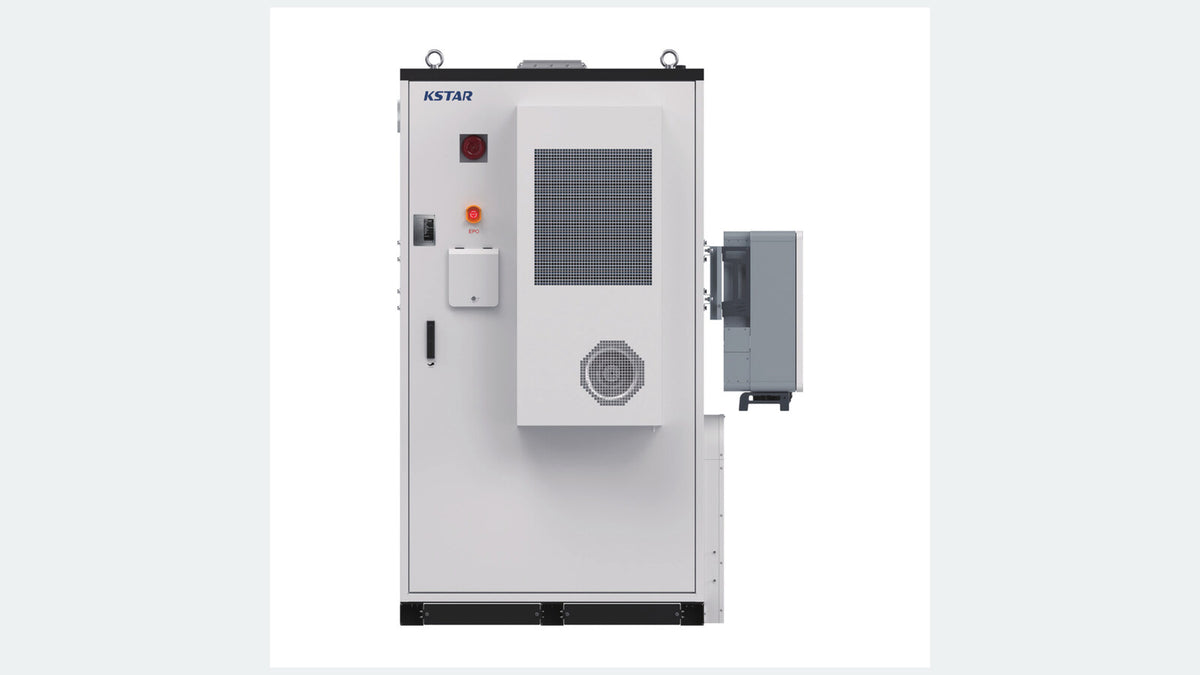
Take an industrial system we install frequently: a 215 kWh KSTAR battery with a 125 kW hybrid inverter. In backup mode, the 125 kW inverter can draw around 107 kW of power from the battery.
Starting a single 15 kW motor uses almost all of this power for a few seconds. If other loads are running at the same time, or two motors start at once, demand exceeds the limit, the inverter trips on overload protection and the backup shuts down for all connected loads.
That is why, when the load includes direct-on-line motors, a 215 kWh battery can be relied on for safe backup of only 25–30 kW. To have real backup for such a load, you need at least three 215 kWh systems, with their inverters. For most businesses, that investment is not justified for backup alone.
| Type of loads on backup | What a 215 kWh battery with a 125 kW inverter can supply | Nectaria recommendation |
|---|---|---|
| Critical or sensitive loads: servers, IT, emergency lighting, alarm, video surveillance, access control, cash registers | Up to approximately 107 kW | Backup recommended |
| Ordinary loads without motors: offices, lighting, sockets, chargers | Up to approximately 107 kW | Backup suitable |
| Machinery with direct-on-line motors: compressors, pumps, large fans, conveyors, machine tools | Only approximately 25–30 kW, safely | No backup; stays on the grid |
What we recommend for a hall with motors
We separate the circuits. Critical loads and loads without motors are moved to a backup panel supplied by the storage system. Machinery with motors stays on the grid. During an outage, the machinery stops as in any interruption, while the servers, lighting, alarm and other critical loads keep running without interruption.
This way you use all the power available from the battery, about 107 kW with a 125 kW inverter, for the loads that really matter during an outage. The rest of the time, the battery remains just as useful for self-consumption and peak shaving.
If your motors already have a soft starter or a variable frequency drive, the starting current drops considerably and the calculation changes. We check this on site, from the machines' rating plates and diagrams.
Why it matters to know this before the quote
A quote that promises "backup for the whole hall" based only on the battery's capacity in kWh can look good on paper. At the first outage, however, the first motor that starts can shut down the inverter exactly when you need it. Capacity in kWh shows how long a load can be supplied. The inverter's power in kW and the type of loads show whether it can be supplied at all.
What helps us size the backup correctly
- The list of loads that must keep running during an outage, and for how long.
- Photos of the motor rating plates, and whether they start direct-on-line, with a soft starter or with a drive.
- The machines that can start at the same time.
- The approved power from the ATR (grid connection technical approval) or the distribution contract, and recent bills.
- Photos of the main switchboard and the sub-distribution boards.
You can view the storage systems for halls, farms and factories and our guide to KSTAR industrial batteries with backup.
Call +40 723 172 359 or message us on WhatsApp. Together we review the hall's loads and decide what is worth putting on backup before the quote.

Leave a comment
This site is protected by hCaptcha and the hCaptcha Privacy Policy and Terms of Service apply.