
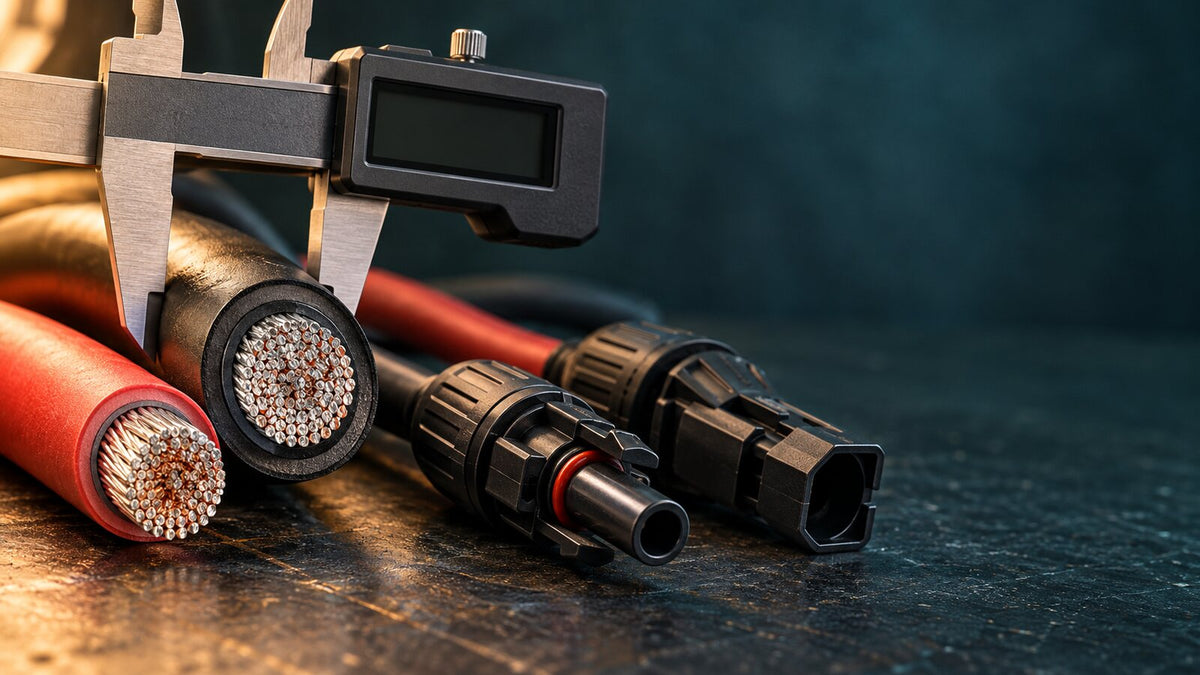
Cable and connectors are key components of a PV system. They must carry current with controlled losses and withstand the environment in which they are installed. A good panel does not make up for a non-compliant conductor, unsuitable insulation or a poorly made contact. Connector defects can lead to overheating, inverter shutdowns and, in severe cases, electric arcing or fire. PVEL–HelioVolta guide.
At Nectaria we use 6 mm² solar cable from established manufacturers and original Stäubli MC4 connectors. For you, quality must be verifiable through the product, the documentation and the installation. Below we explain the difference compared with 4 mm², what the term "fire-resistant" really means, and what is worth asking for before installation.
"Solar cable" should mean more than a marking
The European standard EN 50618 covers PV cables for long-term use, including outdoors. It covers flexible, halogen-free constructions with low emission of smoke and corrosive gases. H1Z2Z2-K is the designation used for this family of cables. The marking must be backed by the product documentation. EN 50618 overview and H1Z2Z2-K explained.
IEC 62930 is an international standard for DC photovoltaic cables. It also includes variants that may contain halogens. Therefore, citing it alone does not prove that a product is halogen-free or that it has all the properties of another cable. Official IEC 62930 scope.
Fire-resistant or flame-retardant?
The precise term is "flame-retardant" (resistant to flame propagation). The EN/IEC 60332-1-2 test checks a single vertical cable under defined conditions. It does not mean the material cannot burn, and it does not automatically describe the behaviour of a bundle of cables. IEC test description.
Being halogen-free, the amount of smoke and UV resistance are different properties. Halogens are a family of elements that can be part of a material's composition; the cable documentation specifies the tests on emitted gases. Insulation exposed on the roof must also be assessed for UV, ozone and weathering. Example of a HELUKABEL technical declaration.
This example shows what you can check in a document. We do not automatically attribute all the characteristics of another manufacturer's cable to the cable in a quote. Ask for the datasheet and certificate for the brand and model that will be installed at your property.
6 mm² vs 4 mm²: the measurable advantage
For the same length and the same current, a 6 mm² conductor has lower resistance and reduces losses compared with 4 mm². For tinned, flexible, class 5 copper, the published maximum values at 20°C are 5.09 ohm/km for 4 mm² and 3.39 ohm/km for 6 mm². The ohm is the unit of electrical resistance. LAPP datasheet, page 4.
A 4 mm² cable can be correctly sized. The choice depends on current, length, temperature, cable grouping and installation method. Using 6 mm² reduces losses under comparable conditions, but it does not replace proper installation design. Criteria explained by Nexans.
Example: 30 m to the inverter, 10 A current
We consider two conductors of 30 m each: one outgoing and one return. The total length is 60 m. The calculation uses the maximum resistance values above, at 20°C, excluding connector losses.
- 4 mm²: the loop resistance is 5.09 × 0.060 = 0.3054 ohms. At 10 A, the voltage drop is 3.054 V and the loss is 30.54 W.
- 6 mm²: the loop resistance is 3.39 × 0.060 = 0.2034 ohms. At 10 A, the voltage drop is 2.034 V and the loss is 20.34 W.
- At 400 V and 4,000 W: the calculated losses are approximately 0.764% and 0.509% respectively.
In this example, 6 mm² reduces the cable loss by approximately 33.4%, i.e. 10.2 W at the chosen current. This does not mean 33% more system production. Temperature, current and losses change during operation. The calculation is based on the values published by LAPP.
Can a cable marked 6 mm² have too little copper?
Yes. On the market we have come across cables marked "6 mm²" which, when measured, contain less copper than they should. That is also where their lower price comes from. You can't see any difference with the naked eye: the sheath looks the same and the marking is identical. The problem is not ours alone. The British certification body BASEC has been warning for years about cables with too little copper and excessive resistance. BASEC's explanations.
How can you check? Weighing the cable or measuring its diameter gives a first indication, but the reliable check is the electrical resistance of the conductor over a known length. The standard sets a maximum value for each cross-section. A cable with too little copper has higher resistance, heats up more and loses more energy. IEC 60228, definitions and verification.
Original MC4 and approved pairings
MC4 is a Stäubli brand. Two connectors that physically fit together are not automatically compatible. Stäubli's instructions prohibit mating its products with connectors from other manufacturers. Differences can affect contact and sealing. Official MA298 instructions.
Use pairings approved by the manufacturer, including the permitted combinations between certain Stäubli products. The approved cable, outer diameter, contact and tools used also matter. Being original does not make up for incorrect installation. Do not disconnect connectors under load. Stäubli intermateability matrix and installation instructions.
Why replacement can cost more than the initial saving
A faulty contact can cause shutdowns, inactive panel strings and investigations to locate the problem. The cost can include roof access, replacement and lost production. Who pays depends on the warranty and contractual liability; either way, the owner bears the inconvenience of an installation that is out of service. Failure modes documented by PVEL–HelioVolta.
A short checklist for homeowners
- Ask for the brand, model and datasheet of the proposed cable.
- Check the standards and documents on flame behaviour, UV and insulation.
- Ask for the cross-section to be justified for the length of your cable run.
- Check the connector brand and the approved pairings.
- Request the warranty documents and the remedy terms.
For a system with clearly specified materials, call 0723 172 359 or message us on WhatsApp. Nectaria has been active since 2011 and is ANRE-certified (C1A and C2A). See our systems with batteries and the article Cheap to install, expensive to service.

Leave a comment
This site is protected by hCaptcha and the hCaptcha Privacy Policy and Terms of Service apply.