
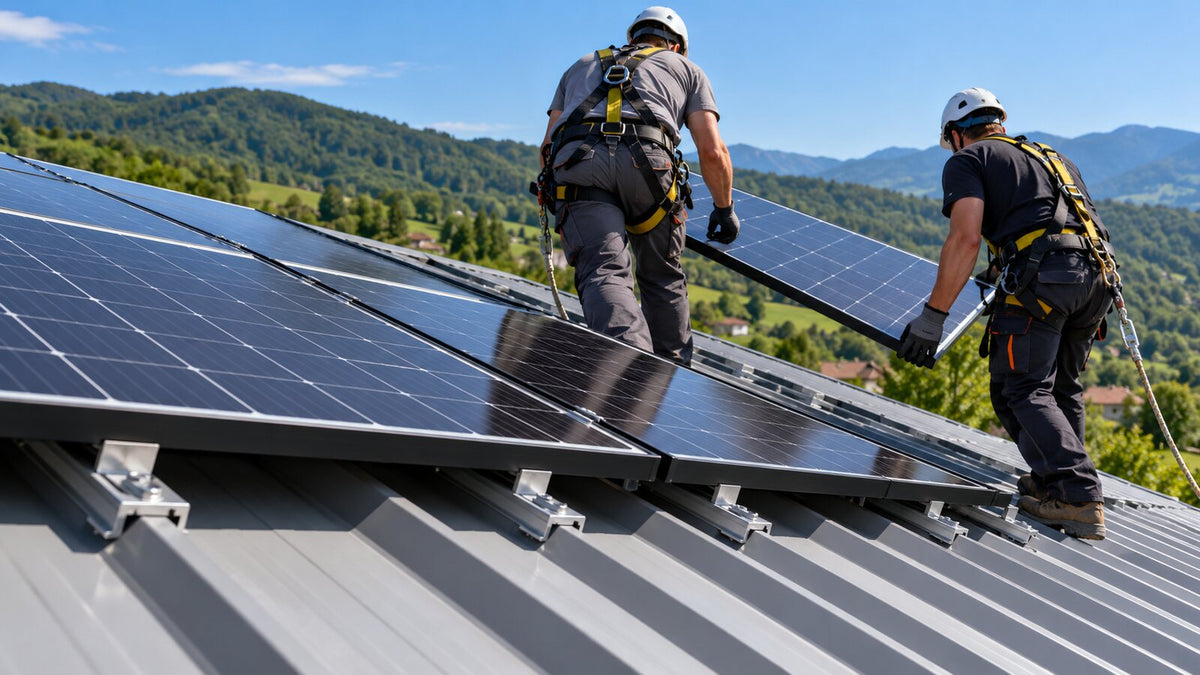
Trapezoidal sheet and tile-effect metal roofing require different mounting solutions. The shape of the roof covering changes the fixing method, the load path and the sealing details. A structure chosen only by the look of the roof can put both the panels and the roof covering at risk.
At Nectaria we start from the exact type of metal sheet and the substrate beneath it. For you, this check clarifies whether we can use mini rails fixed directly into the sheet or whether profiles and anchoring to the load-bearing elements are needed.
Corrugated or trapezoidal sheet: when we use mini rails
Mini rails are short profile sections on which the panel clamps are mounted. On a compatible trapezoidal sheet, they can be fixed directly into the high ribs, using the screws and seals specified by the system. This means that a continuous rail along the entire row is not needed in every configuration.
This solution is permitted only if the sheet profile, material, thickness and fixing strength meet the system requirements. The fixing of the roof covering to the building structure must also be checked. A well-fixed mini rail on a poorly anchored sheet does not solve the strength problem.
On corrugated sheet, we check the actual geometry of the corrugations. A sheet with a different profile does not become compatible just because it has ribs. Mini rail positions must also respect the zones where the panel manufacturer allows the clamps to be tightened.
Tile-effect metal roofing: adapted profiles and fixings
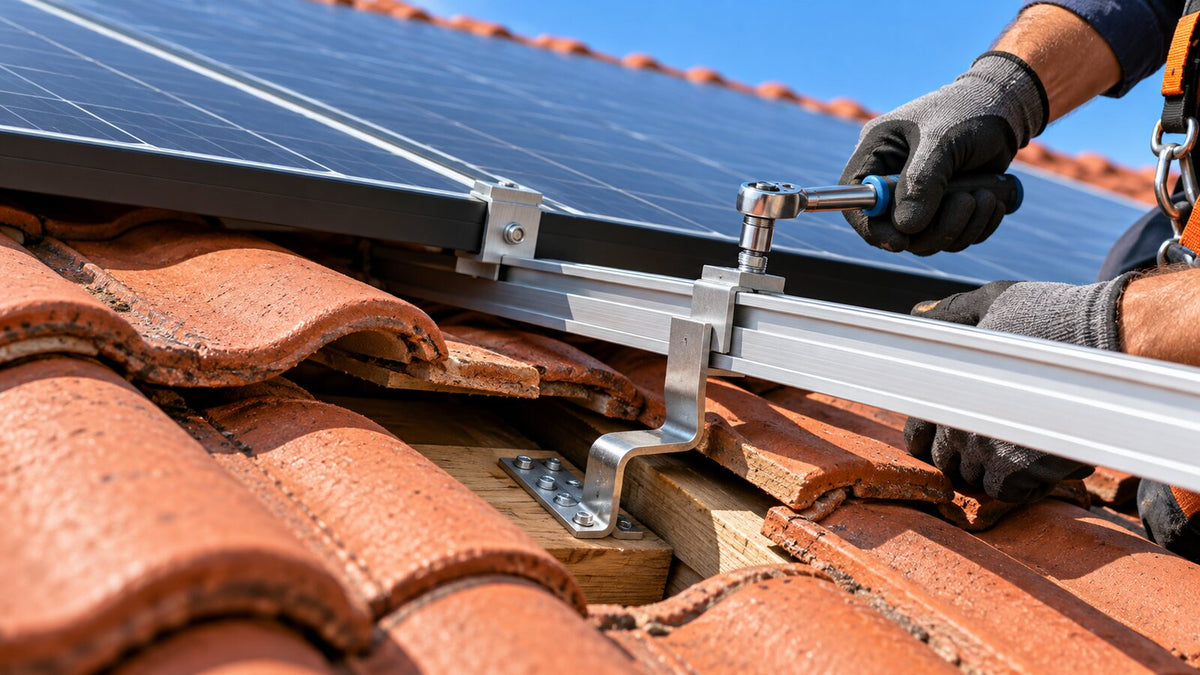
Tile-effect metal roofing has steps and shapes that require a different support geometry. We use profiles and fixings suited to the roof covering and the load-bearing substrate. Where appropriate, anchoring is made into timber or metal, using a properly designed and sealed detail.
We do not automatically transfer a mini rail from trapezoidal sheet to tile-effect roofing. Nor are the screws already in the roof automatically anchor points for panels. Each element must be checked for the new load.
In our structures collection you will find mini rails, metal-roof profiles, connectors and clamps. The components are chosen together. A good profile with an unsuitable clamp or the wrong screw does not make a correct structure.
Sheet thickness matters, but it is not the only criterion
For direct fixing, the minimum permitted thickness is the one stated in the system documentation for the material in question. A value for steel does not automatically apply to aluminium. We do not recommend a universal thickness for all mini rails and all roofs.
We check the roof covering documentation and, where necessary, the actual thickness. Rust, deformation and old holes can change the assessment. With sandwich panels, the panel build-up, the fixings and technical approval for the mounting solution also matter, not just the visible metal sheet.
How holes are sealed
Fixings that penetrate the sheet need compatible seals or sealing tapes, often EPDM, according to the chosen system. The surface must be prepared and the screw tightened in a controlled manner. A seal that is not compressed enough may not seal; one crushed by overtightening can be damaged.
The hole position is determined by the mounting detail. Metal swarf is removed and the protection of the roof covering is maintained according to its instructions. Silicone applied over a faulty fixing does not replace the seal and does not correct an enlarged hole. Watertightness is checked, without absolute promises about performance in all conditions.
Snow, wind and distances from the ridge
In Romania, design takes the site into account, using CR 1-1-3/2012 for snow action and CR 1-1-4/2012 for wind action, with the applicable amendments. Exposure, building height and roof shape influence the loads.
Setbacks from the sides, eaves and ridge are determined for each project. Corner and edge zones can be subject to higher wind loads. The number of screws and the spacing between mini rails are not chosen just to use as few parts as possible.
Materials, earthing and final checks
Aluminium profiles, stainless steel screws where specified and dedicated fixing elements must be compatible with the metal sheet. For direct fixing, the screw material approved by the system is used; stainless steel picked at random is not a sufficient rule. Avoiding corrosion where different metals are in contact is also considered.
The structure and the frames are connected to the protection system and to earth according to the electrical design. Mechanical contact does not prove electrical continuity. The panel installation manual explains the requirements for earthing connections. These are checked, including between separate segments.
- We check fixings, clamps and tightening torques against the documentation.
- We check the seals and the penetrations through the roof covering.
- We secure cables away from sharp edges, water and sheet movement.
- We keep access to roof elements that require maintenance.
Savings made by leaving out fixings can turn into a difficult repair after the first problem. The structure supports the entire investment. Nectaria is a direct importer and distributes equipment and structures to installation companies across Romania. Our warehouse is in Alba Iulia, str. Livezii nr. 35A.
Compare also the solutions for tile roofs, flat roofs or ground mounting. For connections, read our guide to 6 mm² solar cable and original connectors.
Send photos of the roof and its dimensions via WhatsApp at 0723 172 359, and we will choose the right structure. See our mounting structures and our systems with installation, without batteries or with batteries. Phone: 0723 172 359.

Leave a comment
This site is protected by hCaptcha and the hCaptcha Privacy Policy and Terms of Service apply.